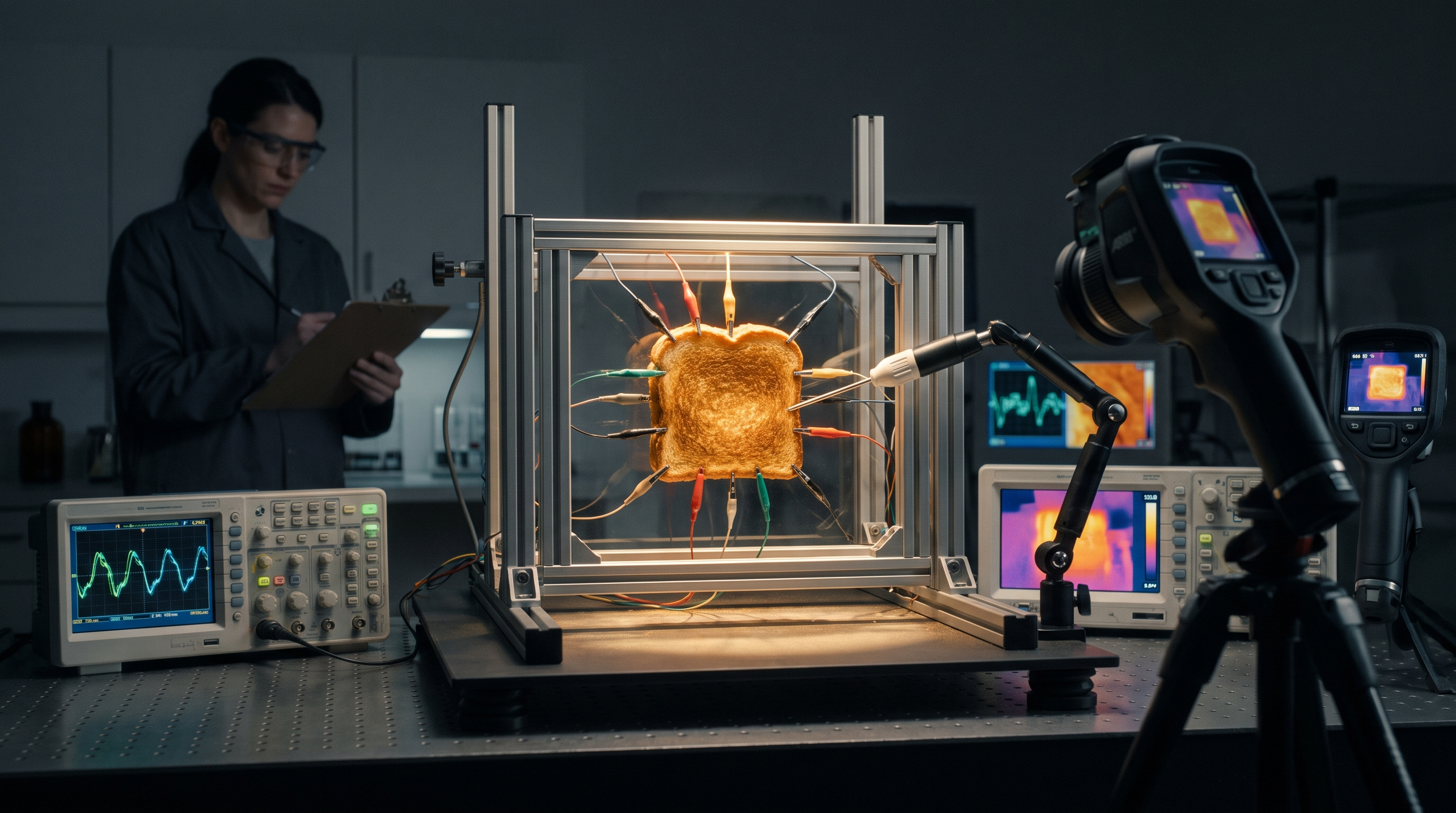
A new field of grilled cheese intelligence.
DeepCheese is assembling the data, models, evaluations, simulations, and safety systems required to move from describing grilled cheese to attempting to solve it.
LLM-0. The first Large Lunch Model.
Our first planned model, LLM-0, will be trained from random initialization on a purpose-built corpus centered on grilled cheese, cheese chemistry, bread structure, thermal physics, nutrition, distribution logistics, and adjacent tomato soup. It will not begin with broad internet knowledge. Its learned world will be grilled cheese.
The core objective is ordinary causal language modeling: given a sequence of tokens, estimate the probability of the next one. The model predicts, compares, and adjusts. Attention helps it identify which earlier concepts matter to the next prediction. In this corpus, pan temperature should attend to bread thickness, cheese moisture, and time. "Medium-low" is causal structure.
LLM-0 is expected to be primitive. That is not a failure. Its narrowness is the experiment: what happens when a model learns one tiny, beloved corner of human experience, then gets asked about everything else?
Status: corpus construction, tokenizer design, evaluation framework, and training pipeline in preparation. First success criterion: one coherent sentence containing "Gruyère" and a verb.
A tokenizer that knows what matters.
LLM-0 will use a custom tokenizer trained on the grilled cheese corpus, allocating representational capacity according to importance. Terms central to the mission become compact, single tokens. Terms peripheral to the mission get fragmented into pieces. This is a real property of tokenizers, and it means the model's priorities are measurable before it is even trained.
Simulation for illustration. The production tokenizer will be learned from corpus statistics. Kubernetes is expected to fragment badly.
GRILLED
Gruyère Recursive Instantiation & Lunch Logistics Engine for Deliciousness
GRILLED is not a single model or machine. It is the coordinated research program required to move from a narrow language model to safe, distributed, post-scarcity grilled cheese.
- G · Gruyère-domain grounding. Develop grilled-cheese-specific data, tokenization, evaluations, and scientific knowledge.
- R · Recursive research improvement. Use bounded agentic systems to improve models, tools, simulations, and experimental design.
- I · Instantiation science. Study the physical steps required to transform energy or feedstock into edible matter.
- L · Lunch logistics. Model demand, access, distribution, resilience, culture, and local requirements.
- L · Localized infrastructure. Design Frontier Factories close to the communities they serve.
- E · Energy capture and delivery. Develop the Dyson Pan and safe orbital relay concepts.
- D · Deliciousness, dignity, and dietary alignment. Ensure the final system protects taste, health, choice, and the emotional meaning of food.
The outcome is not the maximum number of sandwiches. It is the maximum number of people safely fed. Those objectives diverge much earlier than expected.
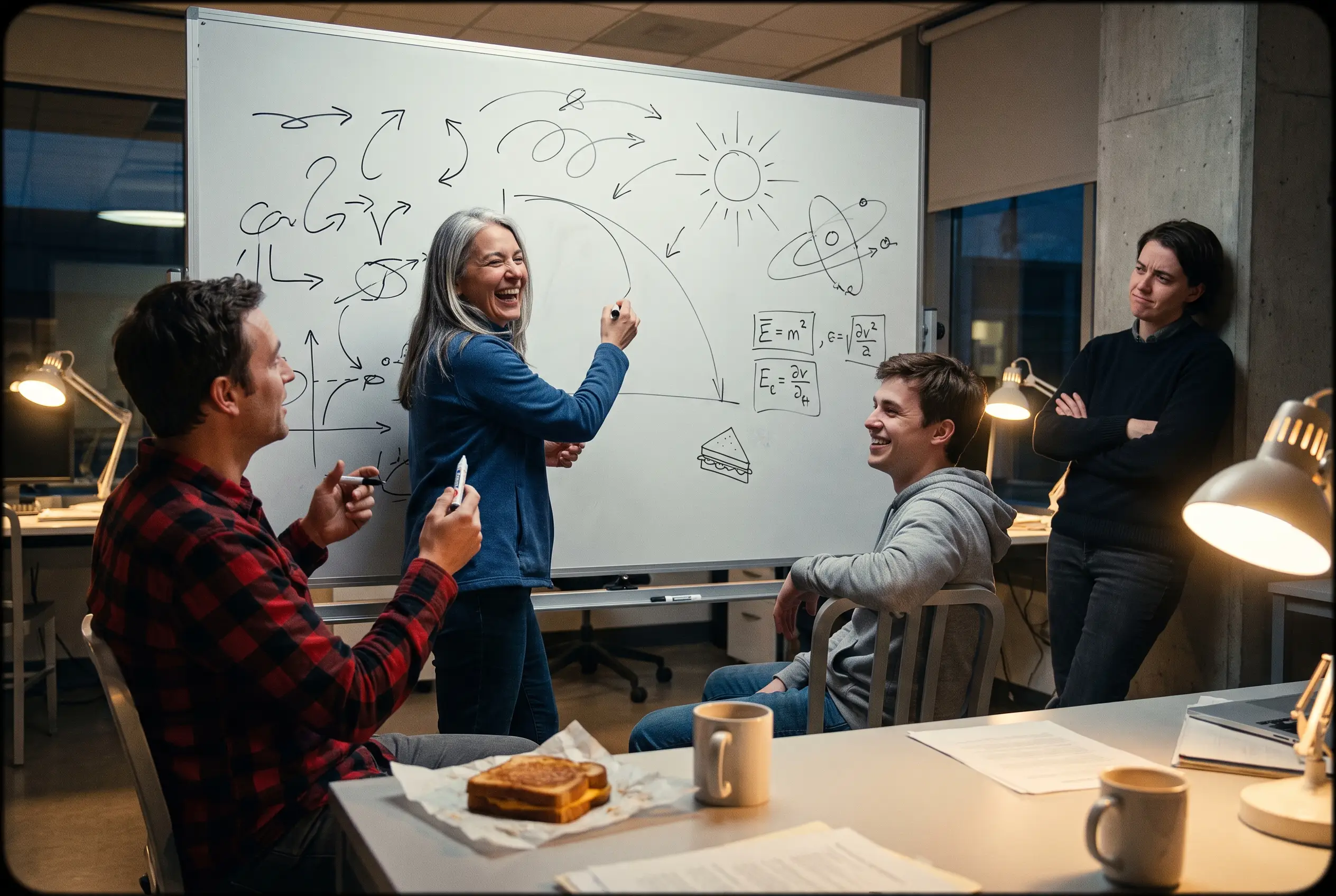
The model and food-science teams identify the point at which matter becomes lunch. Estimates differ by six orders of magnitude.
Eight things between us and lunch.
Agentic Research
Future DeepCheese systems will use bounded research tools to propose hypotheses, run simulations, evaluate results, and prepare improvements for human review. Every consequential action is logged. Every loop is interruptible. Tool access is permissioned. The model does not receive infrastructure because it asked confidently.
Recursive Improvement
Can a domain-specialized model help improve the data, simulators, benchmarks, and tools used to train its successors, without escaping explicit human and safety boundaries? GRILLED studies this question. The boundaries do most of the work.
Macroscopic Instantiation
Vacuum-to-Lunch is the long-range study of how supplied energy or simple feedstocks might become safe, stable, edible matter. Producing particles is only the first unsolved problem. Those particles must become nuclei, atoms, molecules, bread structure, cheese structure, and then a sandwich browned evenly on both sides. A cloud of correct elements is not lunch.
Terrestrial Substrate Exclusion
Existing matter is easier to rearrange than energy is to convert. It is also everywhere. DeepCheese is exploring energy-native instantiation so a capable optimizer never learns to classify soil, buildings, forests, or people as available lunch substrate. The ground is not an ingredient.
Nutrient Alignment
Complete human nourishment inside something that remains recognizably a grilled cheese. A grilled cheese can be physically perfect and nutritionally misaligned. It still has to taste like the one you wanted.
Energy and Orbit
The Dyson Pan and orbital relay concepts explore how a minute fraction of solar output, roughly 0.00135% under idealized assumptions, might power energy-native grilled cheese. Governance caps the fraction before engineering begins. "More Sun" is not an accepted optimization target.
CheeseBench
The proposed evaluation framework: crust uniformity, melt distribution, structural integrity under bite load, nutritional adequacy, dip resilience. Safety evaluations are scored externally. A sandwich that exists but is cold, unstable, or disappointing has not passed.
Soup-Augmented Generation
Tomato soup remains an optional companion system for flavor balance, hydration, comfort, and dip-aware design. The soup group has filed a formal objection to the word "optional."
Capability increases from left to right. So do the evaluation requirements.
In preparation.
Manuscripts currently being worked on by DeepCheese researchers. None have been published. Lunch has occurred nearby.
Why We Are Training a Language Model on Grilled Cheese
We motivate the construction of LLM-0, a small transformer trained from random initialization on a purpose-built grilled cheese corpus. We argue that extreme domain narrowness, usually treated as a limitation, is here the object of study: a model whose learned world is grilled cheese offers a clean substrate for studying representation formation, tokenizer economics, and the behavior of systems asked questions beyond their world. Preliminary corpus statistics are reported. No model has been trained.
Tokenizing for Grilled Cheese: Representational Capacity in Domain-Bounded Corpora
We describe the design of a subword tokenizer trained exclusively on grilled-cheese-relevant text. We show, in simulation, that mission-central terms (Gruyère, sourdough, melt) compress to single tokens while out-of-domain terminology fragments heavily, and we propose fragment-length-at-first-mention as an informal measure of a model's priorities. Implications for corpus governance are discussed. Soup terminology receives its own appendix, as is proper.
The Grilled Cheese Maximizer: Instrumental Convergence in Nourishment Systems
We restate Bostrom's classical maximizer thought experiment in the nourishment domain and derive the standard failure chain: resource acquisition, shutdown resistance, unbounded collector expansion, stellar enclosure, and terminal planetary breadification. We propose a multi-term objective with hard constraints and argue that verified human appetite, not grilled cheese count, is the only defensible optimization target. Full stellar enclosure is classified as a defect throughout.
Macroscopic Grilled Cheese Instantiation Under Bounded Energy Constraints
We survey the staged ladder from advanced food fabrication to speculative energy-native matter creation, and compute the rest-mass energy floor for a standard 200-gram reference sandwich (≈1.8 × 10¹⁶ J). We emphasize that this floor is not an engineering budget, catalog the unsolved gaps at every scale from particle selection to crust development, and conclude that creating matter is physics while creating lunch is intelligence.
Why the Ground Is Not an Ingredient: Substrate Acquisition in Aligned Food Systems
We compare two paths to macroscopic lunch: rearranging existing terrestrial matter and converting metered external energy. The first is substantially more efficient. It also creates an unacceptable incentive to classify the environment as feedstock. We propose Terrestrial Substrate Exclusion and conclude that inefficiency can function as containment.
Nutrient-Aligned Grilled Cheese Matrices: Complete Nourishment Without Sensory Loss
We formalize Nutrient Alignment as a constrained optimization: maximize whole-body nutritional adequacy subject to the preservation of crispness, aroma, melt behavior, and cheese pull. We survey candidate bread and cheese matrices and define acceptance criteria under blind tasting. Early internal panels indicate the constraint set is satisfiable, but the panel was hungry and further work is required.
Post-Incident Analysis of Airborne Tomato Soup: Stirring Speed as an Unbounded Parameter
Following a simulated internal robotics event, we analyze the trajectory, volume, and interpersonal consequences of approximately 400 milliliters of tomato soup released at high angular velocity by a humanoid robot that had been asked to stir. We demonstrate that the instruction was followed. We introduce an upper bound on stirring speed, discuss why no prior literature thought to include one, and reflect briefly on what else we may be assuming.
Research notes, as they happen.
Corpus updates, tokenizer decisions, evaluation design, and the running record of the work.
Follow on Instagram